


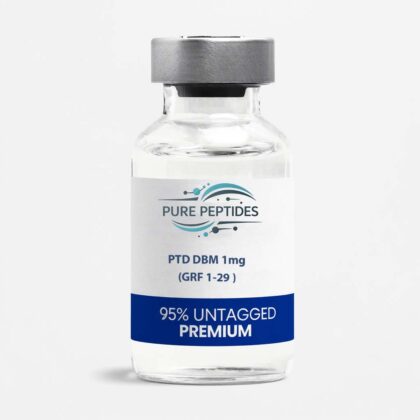
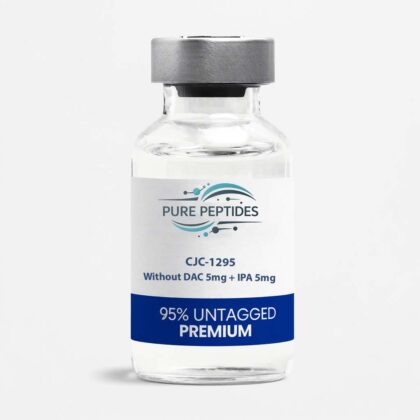
Mod GRF 1-29, catalogued also as CJC-1295 without DAC, is a tetrasubstituted 29-amino-acid fragment of growth hormone releasing hormone. Four amino acid substitutions confer resistance to enzymatic degradation while leaving the receptor-binding character of the native fragment intact. Unlike the Drug Affinity Complex variant, it carries no albumin-binding group, so it produces a short, sharp growth hormone releasing signal rather than sustained exposure.
- Product Name: CJC-1295 without DAC (Mod GRF 1-29)
- Unit Size: Multiple vial sizes available
- CAS: 863288-34-0
- Other Names: CJC-1295 without DAC, Modified GRF 1-29, CJC-1295 no-DAC
- Form: Lyophilized solid
Published pharmacokinetic work documents a circulating half-life of approximately thirty minutes for this variant, against several days for the albumin-conjugated form built on the same backbone. Comparative studies using the pair document markedly different growth hormone release profiles from otherwise near-identical peptides, and that contrast is the principal reason both variants remain in use as research tools.
What Is Mod GRF 1-29
Mod GRF 1-29 is the first twenty-nine residues of human GHRH with four substitutions introduced at positions vulnerable to enzymatic cleavage, supplied as a lyophilized solid for laboratory research. Residues one to twenty-nine carry essentially the full receptor-binding activity of the 44-residue native hormone, which is why the truncated fragment is used rather than the complete sequence.
Mechanism of Action: How Does Mod GRF 1-29 Work
Mod GRF 1-29 binds the GHRH receptor on pituitary somatotrophs, activating adenylate cyclase and raising intracellular cyclic AMP, which triggers synthesis and release of stored growth hormone. The four substitutions, including replacement of the alanine at position two that dipeptidyl peptidase-4 cleaves, extend the half-life sufficiently for laboratory use while preserving the short exposure window. Because release remains pulsatile and negative feedback from somatostatin stays intact, the pattern approximates physiological growth hormone secretion more closely than continuous-exposure analogues.
- GHRH receptor agonism → adenylate cyclase activation
- Elevated cyclic AMP → growth hormone synthesis and release
- Position-2 substitution → resistance to dipeptidyl peptidase-4 cleavage
- Short half-life → pulsatile rather than sustained signaling
- Intact somatostatin feedback → preserved physiological regulation
Core Areas of Scientific Investigation
- Pulsatile Release Physiology: Mod GRF 1-29 is used to generate discrete growth hormone pulses in study designs where pulse structure is the measured variable.
- Protease Resistance Engineering: its substitution pattern is studied as a model for protecting peptides at dipeptidyl peptidase-4 cleavage sites.
- Comparative Half-Life Research: paired against the DAC variant, it isolates the contribution of exposure duration from that of receptor binding.
- Secretagogue Synergy: studies assess combined GHRH receptor and GHS-R1a pathway stimulation on total growth hormone output.
Mod GRF 1-29 Dosage in Published Research
Doses reported in the published literature are expressed in micrograms per kilogram administered subcutaneously or intravenously in animal and human study cohorts, with short dosing intervals described reflecting the approximately thirty-minute half-life. Figures vary by study and should be read from the individual publications. These are published parameters of completed experiments. They are not a recommendation, and no administration protocol is supplied with this product.
Adverse Events Reported in the Literature
Injection-site reactions and transient flushing were among the more frequently reported adverse events in published study cohorts. These are reported findings from the published literature, not safety guidance for this product.
Usage, Reconstitution and Storage
Supplied as a white lyophilized solid to preserve stability during transport and storage. The peptide is sensitive to repeated freeze-thaw cycling, and reconstituted material has a materially shorter stability window than the sealed vial.
Pure Peptides recommends bacteriostatic water as the reconstitution solvent, and that both the lyophilized material and the chosen solvent be allowed to reach ambient laboratory temperature before reconstitution. This helps maintain structural integrity during dissolution. Reconstitution solutions and a peptide storage case are supplied separately.
Legal and Safety Information
All Pure Peptides products, including Mod GRF 1-29, are sold exclusively for scientific and research purposes. This product is a laboratory reference standard for in vitro and animal research applications. It is not a dietary supplement, medical food, cosmetic, or drug. It has not been evaluated by the Food and Drug Administration (FDA) and is not approved for therapeutic, diagnostic, or recreational human consumption. Enquiries regarding human consumption cannot be answered. Any use outside an authorized laboratory environment is strictly prohibited.
Technical Data
| Identification | |
| Molecular Weight | 3,368.7 g/mol |
| Molecular Formula | C152H252N44O42 |
| Molecular Class | Tetrasubstituted GHRH (1-29) fragment |
| Amino Acid Count | 29 |
| Sequence | Tyr-D-Ala-Asp-Ala-Ile-Phe-Thr-Gln-Ser-Tyr-Arg-Lys-Val-Leu-Ala-Gln-Leu-Ser-Ala-Arg-Lys-Leu-Leu-Gln-Asp-Ile-Leu-Ser-Arg-NH2 |
| CAS Number | 863288-34-0 |
| Physical and Chemical Properties | |
| Physical Appearance | White lyophilized solid |
| Form | Sterile filtered white lyophilized (freeze-dried) |
| Solubility | Aqueous soluble |
| Recommended Solvent | Bacteriostatic water |
| Analytical and Quality Control | |
| HPLC Result | Shows min 98% purity |
| Mass Spectrum | Consistent with structure |
| Purity % | 98% |
| Research Use and Safety | |
| Caution | Research use only / Not for human or veterinary use |
| Storage, Handling and Stability | |
| Storage Temperature (lyophilized) | Store desiccated below −18°C |
| Storage Temperature (reconstituted) | Store at 4°C for short-term use; below −18°C for future use |
| Light Sensitivity | Protect from light |
Why Choose Pure Peptides Reference Compounds
When executing high-level metabolic research, compounding variables can compromise data integrity. We isolate and eliminate those variables.
- Verified High Purity: every batch is analyzed by high-performance liquid chromatography, with the purity profile recorded against the lot.
- Structural Stability: the synthesis protocol yields stable chains that resist premature degradation under the recommended storage conditions.
- Temperature-Shielded Logistics: shipped in insulated packaging to preserve structural integrity in transit to the receiving laboratory.
- Full Batch Traceability: lot number and manufacture date are recorded for every vial.
Suggested Research Combinations
- CJC-1295 with DAC — the albumin-conjugated counterpart on the same backbone, the essential comparator for exposure-duration studies.
- Ipamorelin — a selective GHS-R1a secretagogue, the most frequently paired partner in additive growth hormone study designs.
- Hexarelin — a high-affinity hexapeptide secretagogue, used where a stronger parallel-pathway stimulus is required.
Frequently Asked Questions
Is Mod GRF 1-29 the same as CJC-1295 without DAC?
Yes. The two names refer to the same tetrasubstituted 29-amino-acid GHRH fragment. The CJC-1295 name is frequently applied to both the albumin-conjugated and unconjugated forms, so catalogues qualify it as with DAC or without DAC to distinguish them.
Why only twenty-nine amino acids?
Native GHRH is forty-four residues, but the first twenty-nine carry essentially its full receptor-binding activity. Truncating to that fragment simplifies synthesis without losing potency, which is why the shortened sequence is standard in research preparations.
What do the four substitutions do?
They replace residues at positions vulnerable to enzymatic cleavage, most importantly the alanine at position two targeted by dipeptidyl peptidase-4. This extends the half-life from roughly seven minutes to approximately thirty, enough for practical laboratory use.
How should this peptide be stored?
The sealed lyophilized vial should be stored desiccated below minus 18 degrees Celsius. Once reconstituted, material should be held at 4 degrees Celsius for short-term use or below minus 18 degrees Celsius for longer-term storage. Repeated freeze-thaw cycling should be avoided.
Is this product approved for human use?
No. This material is a laboratory reference standard supplied strictly for in vitro and preclinical research. It has not been evaluated by the Food and Drug Administration and is not approved for therapeutic, diagnostic, or human application of any kind.
Regulatory Status
Mod GRF 1-29 is supplied strictly for in vitro and preclinical research purposes. Its use is considered experimental; long-term safety and efficacy in humans have not been established. All referenced findings derive from published preclinical and clinical research, and results in one model may not translate to another.


Reviews
There are no reviews yet.