
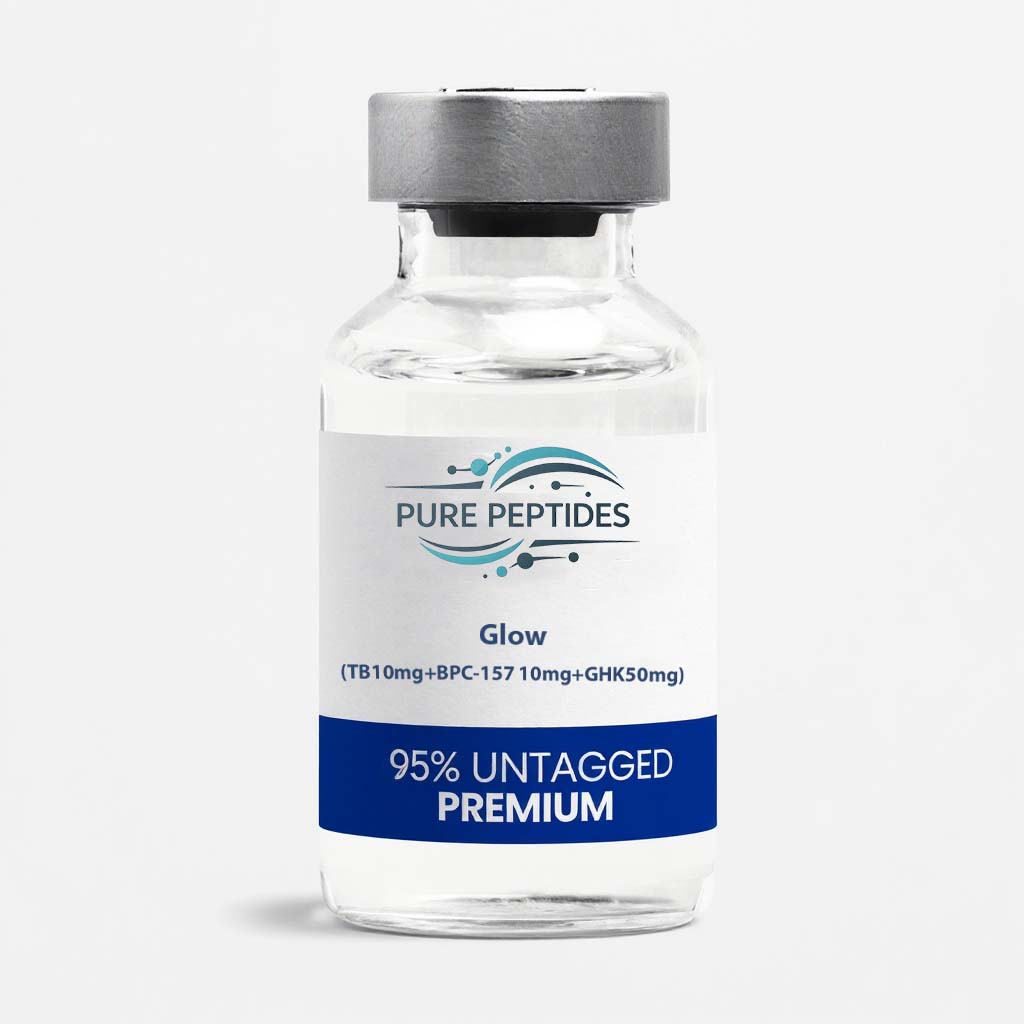

The Glow blend is a three-peptide research preparation combining TB-500, BPC-157 and the copper-binding tripeptide GHK. Each addresses a different layer of the tissue-repair problem: actin availability for cell migration, vascular signaling at the injury site, and the extracellular matrix into which repaired tissue is assembled. The blend exists because those three layers are difficult to study in isolation.
- Product Name: Glow Blend (TB-500 10mg + BPC-157 10mg + GHK 50mg)
- Unit Size: 70mg total (TB-500 10mg + BPC-157 10mg + GHK 50mg)
- Other Names: GLOW protocol blend, TB-500/BPC-157/GHK combination
- Form: Lyophilized solids
Each component of the Glow blend carries an independent preclinical literature. Published rodent work documents accelerated closure endpoints for the thymosin fragment in dermal and corneal models, angiogenic responses for the pentadecapeptide in tendon and gastrointestinal injury models, and increased collagen and glycosaminoglycan synthesis for the copper tripeptide in fibroblast culture. Controlled studies of the three-component combination itself are not established in the published record.
What Is the Glow Blend
The Glow blend supplies three distinct research peptides as separate lyophilized vials, packaged together. It is not a co-formulated single product. The name is a community designation rather than a recognized nomenclature, and it refers to this particular three-component grouping as it appears across research-supply catalogues.
Mechanism of Action: How Does the Glow Blend Work
The three peptides act on separate systems. The thymosin fragment binds monomeric G-actin, maintaining a mobilizable reserve that supports rapid filament assembly during cell migration. The pentadecapeptide is associated in published work with VEGFR2–Akt–endothelial nitric oxide synthase signaling and the angiogenic responses documented at injury sites. The copper tripeptide functions as a copper chelator and delivery molecule, supplying the cofactor required by lysyl oxidase, the enzyme that cross-links collagen and elastin. Cytoskeleton, vasculature and matrix are three sequential requirements of tissue repair, which is the rationale for grouping them.
- G-actin sequestration → cell migration capacity
- VEGFR2–Akt–eNOS signaling → angiogenic response at injury sites
- Copper delivery to lysyl oxidase → collagen and elastin cross-linking
- Three sequential repair layers → rationale for combined study designs
Core Areas of Scientific Investigation
- Multi-Layer Repair Research: the Glow blend is used where cytoskeletal, vascular and matrix endpoints are measured within a single study design.
- Dermal Research Models: published work on all three components includes dermal wound closure and granulation tissue formation.
- Extracellular Matrix Assembly: studies assess collagen synthesis and matrix metalloproteinase balance under copper-peptide exposure.
- Component Attribution: supplying all three together supports the single-agent control arms needed to attribute any combined effect.
Glow Blend Dosage in Published Research
Doses reported in the published preclinical literature are expressed separately for each component and cannot be combined into a single figure. The thymosin fragment is reported in micrograms to milligrams per kilogram in rodent models; the pentadecapeptide in micrograms per kilogram per day; the copper tripeptide in nanomolar to micromolar concentrations in culture or at defined percentage concentrations topically. No published protocol establishes a combined ratio. These are published parameters of completed experiments, not a recommendation, and no administration protocol is supplied with this product.
Usage, Reconstitution and Storage
All three peptides are supplied as separate lyophilized solids and are reconstituted individually; they are not pre-mixed. The copper tripeptide is supplied as a blue solid, the color reflecting its coordinated copper ion. All three are sensitive to repeated freeze-thaw cycling and to prolonged light exposure.
Pure Peptides recommends bacteriostatic water as the reconstitution solvent, and that both the lyophilized material and the chosen solvent be allowed to reach ambient laboratory temperature before reconstitution. This helps maintain structural integrity during dissolution. Reconstitution solutions and a peptide storage case are supplied separately.
Legal and Safety Information
All Pure Peptides products, including Glow blend, are sold exclusively for scientific and research purposes. This product is a laboratory reference standard for in vitro and animal research applications. It is not a dietary supplement, medical food, cosmetic, or drug. It has not been evaluated by the Food and Drug Administration (FDA) and is not approved for therapeutic, diagnostic, or recreational human consumption. Enquiries regarding human consumption cannot be answered. Any use outside an authorized laboratory environment is strictly prohibited.
Technical Data
| Identification | |
| Molecular Weight | TB-500: 4,963.44 g/mol |
| Molecular Formula | TB-500: C212H350N56O78S | BPC-157: C62H98N16O22 | GHK: C14H24N6O4 |
| Molecular Class | Actin-sequestering peptide | pentadecapeptide | copper-binding tripeptide |
| Amino Acid Count | TB-500: 43 | BPC-157: 15 | GHK: 3 |
| Physical and Chemical Properties | |
| Physical Appearance | White lyophilized solids; GHK component blue |
| Form | Sterile filtered lyophilized (freeze-dried), supplied as three vials |
| Solubility | Aqueous soluble |
| Recommended Solvent | Bacteriostatic water |
| Research Use and Safety | |
| Caution | Research use only / Not for human or veterinary use |
| Storage, Handling and Stability | |
| Storage Temperature (lyophilized) | Store desiccated below −18°C |
| Storage Temperature (reconstituted) | Store at 4°C for short-term use; below −18°C for future use |
| Light Sensitivity | Protect from light |
Why Choose Pure Peptides Reference Compounds
When executing high-level metabolic research, compounding variables can compromise data integrity. We isolate and eliminate those variables.
- Verified High Purity: every batch is analyzed by high-performance liquid chromatography, with the purity profile recorded against the lot.
- Structural Stability: the synthesis protocol yields stable chains that resist premature degradation under the recommended storage conditions.
- Temperature-Shielded Logistics: shipped in insulated packaging to preserve structural integrity in transit to the receiving laboratory.
- Full Batch Traceability: lot number and manufacture date are recorded for every vial.
Suggested Research Combinations
- Glow with KPV — the four-component preparation adding an anti-inflammatory tripeptide to this same grouping.
- BPC-157 and TB-500 — the two-component pairing without the copper peptide, the control arm for isolating the matrix contribution.
Frequently Asked Questions
What does the Glow blend contain?
Three separate research peptides: TB-500 at 10mg, BPC-157 at 10mg, and the copper-binding tripeptide GHK at 50mg. They are supplied as individual lyophilized vials rather than as a co-formulated single product.
Is Glow a recognized scientific name?
No. It is a community designation for this particular three-component grouping as it appears across research-supply catalogues, not a recognized nomenclature or a name with any regulatory standing.
Why combine these three specifically?
They address three sequential layers of tissue repair: actin availability for cell migration, vascular signaling at the injury site, and copper-dependent cross-linking of the extracellular matrix. Each is difficult to study in isolation from the others.
How should these peptides be stored?
All sealed lyophilized vials should be stored desiccated below minus 18 degrees Celsius and protected from light. Once reconstituted, material should be held at 4 degrees Celsius for short-term use or below minus 18 degrees Celsius for longer-term storage.
Is this product approved for human use?
No. This material is supplied strictly as a laboratory reference standard for in vitro and preclinical research. It has not been evaluated by the Food and Drug Administration and is not approved for therapeutic, diagnostic, or human application of any kind.
Regulatory Status
Glow blend is supplied strictly for in vitro and preclinical research purposes. Its use is considered experimental; long-term safety and efficacy in humans have not been established. All referenced findings derive from published preclinical and clinical research, and results in one model may not translate to another.


Reviews
There are no reviews yet.