
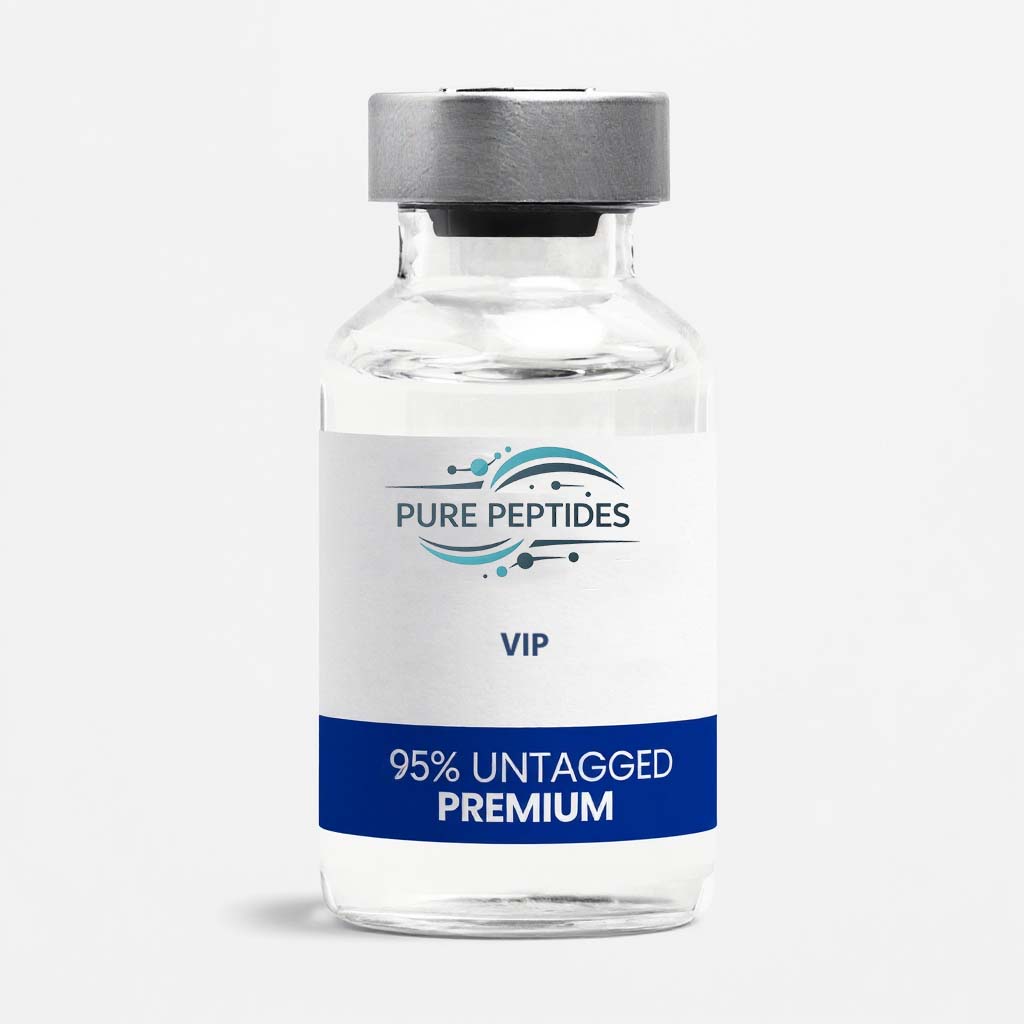

VIP is a 28-residue neuropeptide belonging to the secretin-glucagon superfamily, distributed across the enteric, central and peripheral nervous systems. Its name records the activity by which it was discovered — vasodilation in intestinal tissue — but that turned out to be a small part of what it does: it functions as a neurotransmitter, an immune modulator and a circadian signal, and the breadth is what sustains research interest.
- Product Name: VIP (Vasoactive Intestinal Peptide)
- Catalogue Number: VIP-024
- Unit Size: Multiple vial sizes available
- Other Names: Vasoactive Intestinal Peptide, VIP-28
- Form: Lyophilized solid
The peptide has been characterized across an extensive published literature. Work in the suprachiasmatic nucleus established it as essential for synchronizing the circadian clock, with knockout models showing disrupted rhythms. Separate literature documents anti-inflammatory activity through effects on macrophage and T-cell populations, and enteric studies document smooth muscle relaxation and secretory effects.
What Is VIP
It is a 28-residue peptide supplied as a lyophilized solid for laboratory research. It is structurally related to secretin, glucagon and the GHRH family, which is why analogues in that group frequently show cross-reactivity at VIP receptors and why selectivity controls matter in study design.
Mechanism of Action: How Does VIP Work
The peptide binds two class B G-protein-coupled receptors, VPAC1 and VPAC2, and also engages PAC1 at lower affinity. All couple principally through Gs to adenylate cyclase, raising intracellular cyclic AMP and activating protein kinase A. Distribution determines the outcome: in the suprachiasmatic nucleus VPAC2 signaling synchronizes the firing of individual clock neurons into a coherent rhythm; on immune cells the same cyclic AMP elevation suppresses pro-inflammatory cytokine transcription; in enteric smooth muscle it produces relaxation. One second messenger, three physiological readouts, separated only by which cells express the receptor.
- VPAC1 and VPAC2 agonism → Gs coupling and adenylate cyclase activation
- Elevated cyclic AMP → protein kinase A signaling
- Suprachiasmatic VPAC2 → circadian clock neuron synchronization
- Immune cell signaling → suppressed pro-inflammatory cytokine transcription
- Enteric smooth muscle → relaxation and secretory effects
Core Areas of Scientific Investigation
- Circadian Biology: VIP is essential for synchronizing suprachiasmatic clock neurons, and knockout models show disrupted rhythms.
- Neuroimmune Research: published work assesses cytokine suppression in macrophage and T-cell populations.
- Enteric Nervous System: studies examine smooth muscle relaxation and secretory regulation.
- Receptor Subtype Pharmacology: its activity across VPAC1, VPAC2 and PAC1 makes selectivity controls essential.
VIP Dosage in Published Research
Concentrations reported in the published cell-culture literature are expressed in nanomolar ranges in medium, while rodent studies report nanomoles delivered by intracerebroventricular injection or micrograms per kilogram intravenously. Routes differ substantially across the literature and figures are not interchangeable between them. These are published parameters of completed experiments. They are not a recommendation, and no administration protocol is supplied with this product.
Reported Results in Preclinical Models
Published work documents circadian rhythm disruption in knockout models, cytokine suppression in immune cell culture, and smooth muscle relaxation in enteric preparations. Results in one model may not translate to another.
Usage, Reconstitution and Storage
VIP is supplied as a lyophilized solid to preserve stability during transport and storage. The peptide is sensitive to repeated freeze-thaw cycling, and reconstituted material has a materially shorter stability window than the sealed vial.
Pure Peptides recommends bacteriostatic water as the reconstitution solvent, and that both the lyophilized material and the chosen solvent be allowed to reach ambient laboratory temperature before reconstitution. This helps maintain structural integrity during dissolution. Reconstitution solutions and a peptide storage case are supplied separately.
Legal and Safety Information
All Pure Peptides products, including VIP, are sold exclusively for scientific and research purposes. This product is a laboratory reference standard for in vitro and animal research applications. It is not a dietary supplement, medical food, cosmetic, or drug. It has not been evaluated by the Food and Drug Administration (FDA) and is not approved for therapeutic, diagnostic, or recreational human consumption. Enquiries regarding human consumption cannot be answered. Any use outside an authorized laboratory environment is strictly prohibited.
Technical Data
| Identification | |
| Molecular Weight | 3,326.8 g/mol |
| Molecular Formula | C147H237N43O43S |
| Molecular Class | Secretin-glucagon superfamily neuropeptide |
| Amino Acid Count | 28 |
| Physical and Chemical Properties | |
| Physical Appearance | White lyophilized solid |
| Form | Sterile filtered white lyophilized (freeze-dried) |
| Solubility | Aqueous soluble |
| Recommended Solvent | Bacteriostatic water |
| Analytical and Quality Control | |
| Purity % | 95% |
| Research Use and Safety | |
| Caution | Research use only / Not for human or veterinary use |
| Storage, Handling and Stability | |
| Storage Temperature (lyophilized) | Store desiccated below −18°C |
| Storage Temperature (reconstituted) | Store at 4°C for short-term use; below −18°C for future use |
| Light Sensitivity | Protect from light |
Why Choose Pure Peptides Reference Compounds
When executing high-level metabolic research, compounding variables can compromise data integrity. We isolate and eliminate those variables.
- Verified High Purity: every batch is analyzed by high-performance liquid chromatography, with the purity profile recorded against the lot.
- Structural Stability: the synthesis protocol yields stable chains that resist premature degradation under the recommended storage conditions.
- Temperature-Shielded Logistics: shipped in insulated packaging to preserve structural integrity in transit to the receiving laboratory.
- Full Batch Traceability: lot number and manufacture date are recorded for every vial.
Suggested Research Combinations
- KPV — a tripeptide suppressing NF-kB signaling intracellularly, the comparator for anti-inflammatory mechanism.
- Melatonin — the circadian output hormone, contrasting clock synchronization against downstream signaling.
- Sermorelin — a GHRH analogue from the same peptide superfamily, used to test receptor cross-reactivity.
Frequently Asked Questions
Why is VIP called vasoactive intestinal peptide?
The name records the activity by which it was discovered, vasodilation in intestinal tissue. Subsequent work established far broader roles as a neurotransmitter, immune modulator and circadian signal.
Which receptors does it bind?
It binds VPAC1 and VPAC2, two class B G-protein-coupled receptors, and engages PAC1 at lower affinity. All couple principally through Gs to adenylate cyclase, raising intracellular cyclic AMP.
Why does one peptide produce such different effects?
Because the second messenger is the same everywhere and only the cell type differs. Elevated cyclic AMP synchronizes clock neurons, suppresses immune cytokine transcription, or relaxes smooth muscle, depending purely on where the receptor is expressed.
How should this peptide be stored?
The sealed lyophilized vial should be stored desiccated below minus 18 degrees Celsius. Once reconstituted, material should be held at 4 degrees Celsius for short-term use or below minus 18 degrees Celsius for longer-term storage. Repeated freeze-thaw cycling should be avoided.
Is this product approved for human use?
No. This material is a laboratory reference standard supplied strictly for in vitro and preclinical research. It has not been evaluated by the Food and Drug Administration and is not approved for therapeutic, diagnostic, or human application of any kind.
Regulatory Status
VIP is supplied strictly for in vitro and preclinical research purposes. Its use is considered experimental; long-term safety and efficacy in humans have not been established. All referenced findings derive from published preclinical and clinical research, and results in one model may not translate to another.
Reviews
There are no reviews yet.