


BPC-157 and TB-500 is a dual-peptide research preparation pairing two of the most extensively studied compounds in the tissue-repair literature. BPC-157 is a synthetic pentadecapeptide derived from a gastric protein, associated in rodent work with angiogenic and cytoprotective responses. TB-500 is a fragment of thymosin beta 4, the principal actin-sequestering protein in mammalian cells. Their mechanisms do not overlap, which is the reason they are studied together.
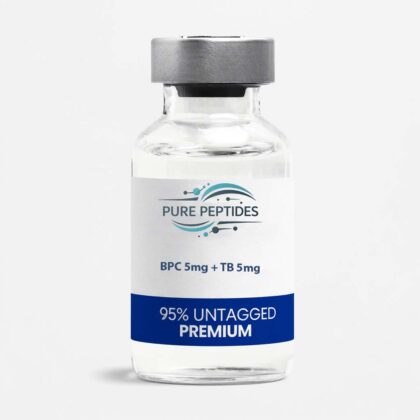
- Product Name: BPC-157 10mg + TB-500 10mg
- Unit Size: 20mg total (BPC-157 10mg + TB-500 10mg)
- Other Names: BPC + TB blend, BPC-157/TB-500 combination
- Form: Lyophilized solid
Each component of BPC-157 and TB-500 carries its own substantial preclinical literature. Published rodent work reports accelerated healing endpoints in tendon, ligament and gastrointestinal injury models for the pentadecapeptide, and accelerated closure in dermal and corneal wound models for the thymosin fragment. Controlled studies comparing the combination against either agent alone remain limited, and that gap is itself a documented open question in the repair-peptide literature.
What Is the BPC-157 and TB-500 Blend
This preparation supplies BPC-157 and TB-500 as a single research article, each lyophilized at 10mg. They are not a co-formulated single molecule: they are two separate compounds packaged together because study designs in tissue repair routinely run them in parallel arms.
Mechanism of Action: How Do BPC-157 and TB-500 Work
The two peptides act through entirely separate routes. The pentadecapeptide has no established single receptor; published mechanistic work describes modulation of the VEGFR2–Akt–endothelial nitric oxide synthase axis, associated with angiogenic responses at injury sites, alongside effects on growth hormone receptor expression in fibroblast culture. The thymosin fragment does not signal through a receptor cascade at all: it binds monomeric G-actin in a one-to-one complex, maintaining a mobilizable reserve of unpolymerized actin that supports rapid filament assembly when a cell begins to migrate. One acts on vascular signaling, the other on cytoskeletal availability.
- VEGFR2–Akt–eNOS signaling → angiogenic response in injury models
- G-actin sequestration → maintained unpolymerized actin reserve
- Rapid filament assembly → cell migration at the leading edge
- Non-overlapping mechanisms → rationale for parallel-arm study designs
Core Areas of Scientific Investigation
- Combination Repair Research: the BPC-157 and TB-500 pairing is used to test whether vascular and cytoskeletal repair mechanisms produce additive endpoints when applied together.
- Tendon and Ligament Models: studies assess fibroblast migration, collagen organization and tensile recovery in rodent transection designs.
- Angiogenesis Studies: published work examines vessel formation and endothelial signaling at injury sites.
- Comparative Arm Design: supplying both peptides together supports the single-agent control arms required to attribute any combination effect.
BPC-157 and TB-500 Dosage in Published Research
Doses reported in the published preclinical literature are expressed separately for each component: micrograms per kilogram per day for the pentadecapeptide, administered intraperitoneally, intramuscularly or orally in rat models, and micrograms to milligrams per kilogram for the thymosin fragment, administered intraperitoneally, subcutaneously or topically. No published protocol establishes a combined ratio. These are published parameters of completed animal experiments. They are not a recommendation, and no administration protocol is supplied with this product.
Adverse Events Reported in the Literature
Published rodent studies of both components have generally reported an absence of observable adverse effects at the doses examined. This reflects the scope of the studies conducted rather than an established safety profile, and no controlled long-term human data exist for either peptide.
Usage, Reconstitution and Storage
BPC-157 and TB-500 are supplied as lyophilized solids to preserve stability during transport and storage. Each vial is reconstituted separately; they are not pre-mixed. Both are sensitive to repeated freeze-thaw cycling, and reconstituted material has a materially shorter stability window than the sealed vial.
Pure Peptides recommends bacteriostatic water as the reconstitution solvent, and that both the lyophilized material and the chosen solvent be allowed to reach ambient laboratory temperature before reconstitution. This helps maintain structural integrity during dissolution. Reconstitution solutions and a peptide storage case are supplied separately.
Legal and Safety Information
All Pure Peptides products, including BPC-157 and TB-500, are sold exclusively for scientific and research purposes. This product is a laboratory reference standard for in vitro and animal research applications. It is not a dietary supplement, medical food, cosmetic, or drug. It has not been evaluated by the Food and Drug Administration (FDA) and is not approved for therapeutic, diagnostic, or recreational human consumption. Enquiries regarding human consumption cannot be answered. Any use outside an authorized laboratory environment is strictly prohibited.
Technical Data
| Identification | |
| Molecular Weight | TB-500: 4,963.44 g/mol |
| Molecular Formula | BPC-157: C62H98N16O22 | TB-500: C212H350N56O78S |
| Molecular Class | BPC-157: synthetic pentadecapeptide | TB-500: actin-sequestering peptide |
| Amino Acid Count | BPC-157: 15 | TB-500: 43 |
| Sequence | BPC-157: H-Gly-Glu-Pro-Pro-Pro-Gly-Lys-Pro-Ala-Asp-Asp-Ala-Gly-Leu-Val-OH |
| Physical and Chemical Properties | |
| Physical Appearance | White lyophilized solids |
| Form | Sterile filtered white lyophilized (freeze-dried), supplied as two vials |
| Solubility | Aqueous soluble |
| Recommended Solvent | Bacteriostatic water |
| Analytical and Quality Control | |
| Mass Spectrum | Consistent with structure |
| Research Use and Safety | |
| Caution | Research use only / Not for human or veterinary use |
| Storage, Handling and Stability | |
| Storage Temperature (lyophilized) | Store desiccated below −18°C |
| Storage Temperature (reconstituted) | Store at 4°C for 2–21 days; below −18°C for future use |
| Light Sensitivity | Protect from light |
Why Choose Pure Peptides Reference Compounds
When executing high-level metabolic research, compounding variables can compromise data integrity. We isolate and eliminate those variables.
- Verified High Purity: every batch is analyzed by high-performance liquid chromatography, with the purity profile recorded against the lot.
- Structural Stability: the synthesis protocol yields stable chains that resist premature degradation under the recommended storage conditions.
- Temperature-Shielded Logistics: shipped in insulated packaging to preserve structural integrity in transit to the receiving laboratory.
- Full Batch Traceability: lot number and manufacture date are recorded for every vial.
Suggested Research Combinations
- GHK-Cu — a copper tripeptide acting on matrix remodeling, the natural third arm in tissue-repair designs.
- Glow blend (TB-500, BPC-157, GHK) — the three-component preparation adding the copper peptide to this same pair.
Frequently Asked Questions
Are the two peptides pre-mixed?
No. They are supplied as two separate lyophilized vials, each reconstituted independently. They are packaged together because tissue-repair study designs routinely run them in parallel arms, not because they form a single co-formulated molecule.
Why are these two studied together?
Their mechanisms do not overlap. One is associated with VEGFR2-mediated angiogenic signaling; the other regulates the availability of monomeric actin for cell migration. Combining them tests whether vascular and cytoskeletal routes produce additive repair endpoints.
Is there published data on the combination itself?
Limited. Each component carries a substantial independent preclinical literature, but controlled studies comparing the combination against either agent alone remain scarce. That gap is a recognized open question in the repair-peptide literature.
How should BPC-157 and TB-500 be stored?
Both sealed lyophilized vials should be stored desiccated below minus 18 degrees Celsius. Once reconstituted, material should be held at 4 degrees Celsius for between 2 and 21 days, or below minus 18 degrees Celsius for longer-term storage. Repeated freeze-thaw cycling should be avoided.
Is this product approved for human use?
No. This material is supplied strictly as a laboratory reference standard for in vitro and preclinical research. It has not been evaluated by the Food and Drug Administration and is not approved for therapeutic, diagnostic, or human application of any kind.
Regulatory Status
BPC-157 and TB-500 is supplied strictly for in vitro and preclinical research purposes. Its use is considered experimental; long-term safety and efficacy in humans have not been established. All referenced findings derive from published preclinical and clinical research, and results in one model may not translate to another.


Reviews
There are no reviews yet.