


Melanotan 2 is a synthetic cyclic analogue of alpha-melanocyte-stimulating hormone (alpha-MSH), the endogenous peptide that regulates melanin production. Unlike the native hormone, which is linear and degraded within minutes, this analogue is cyclized and structurally stabilized, and it engages melanocortin receptors broadly rather than selectively — a non-selectivity that is itself the reason it appears so frequently in receptor-subtype research.
- Product Name: Melanotan 2 (MT-2)
- Unit Size: Multiple vial sizes available
- Other Names: MT-2, Melanotan II, Melanotan 2 acetate
- Form: Lyophilized solid
The analogue has been characterized in published receptor-binding and rodent work documenting agonism across the MC1, MC3, MC4, and MC5 receptor subtypes. Comparative studies against its metabolite PT-141 established that loss of a single terminal amide group substantially reduces MC1 receptor affinity, which is the observation underpinning current understanding of how melanocortin subtype selectivity is structurally determined.
What Is Melanotan 2
Melanotan 2 is a cyclic synthetic peptide analogue of alpha-MSH, supplied as a lyophilized solid for laboratory research. Its cyclic structure confers resistance to enzymatic degradation and a substantially longer duration of receptor engagement than the native linear hormone, which is what makes it practical as a laboratory tool compound.
Mechanism of Action: How Does Melanotan 2 Work
The peptide binds melanocortin receptors, a family of five G-protein-coupled receptors with distinct tissue distributions. At MC1R, expressed on melanocytes, receptor engagement raises intracellular cyclic AMP and activates microphthalmia-associated transcription factor, driving transcription of tyrosinase and shifting melanin synthesis toward eumelanin. At MC3R and MC4R, expressed in hypothalamic nuclei, engagement is associated in animal models with effects on energy balance and autonomic signaling. Because the analogue engages all these subtypes rather than one, it is the standard non-selective reference against which subtype-selective compounds are compared.
- MC1R agonism → elevated melanocyte cyclic AMP
- MITF activation → tyrosinase transcription and eumelanin synthesis
- MC3R and MC4R agonism → hypothalamic energy balance signaling in animal models
- Cyclic structure → protease resistance and extended receptor engagement
- Broad subtype activity → reference compound for selectivity comparisons
Core Areas of Scientific Investigation
- Melanogenesis Pathways: Melanotan 2 is used to study MC1R signaling, tyrosinase induction, and the eumelanin-pheomelanin balance in melanocyte culture.
- Receptor Subtype Mapping: as a broad agonist, it anchors comparisons that isolate the contribution of individual melanocortin receptor subtypes.
- Central Melanocortin Signaling: researchers examine MC3R and MC4R hypothalamic circuits and their autonomic outputs in animal models.
- Structure-Selectivity Research: paired against its metabolite PT-141, it demonstrates how a single structural change redirects subtype selectivity.
Melanotan 2 Dosage in Published Research
Doses reported in the published literature are expressed in micrograms per kilogram administered subcutaneously or intraperitoneally in rodent models, with receptor-binding studies reporting nanomolar concentrations in cell culture. Figures vary by model and endpoint and should be read from the individual publications. These are published parameters of completed experiments. They are not a recommendation, and no administration protocol is supplied with this product.
Adverse Events Reported in the Literature
Nausea, flushing, and reduced appetite were among the more frequently reported effects in published study cohorts, alongside darkening of existing pigmented lesions recorded in case reports. These are reported findings from the published literature, not safety guidance for this product.
Usage, Reconstitution and Storage
Supplied as a lyophilized solid to preserve stability during transport and storage. The peptide is sensitive to repeated freeze-thaw cycling and to prolonged light exposure, and reconstituted material has a materially shorter stability window than the sealed vial.
Pure Peptides recommends bacteriostatic water as the reconstitution solvent, and that both the lyophilized material and the chosen solvent be allowed to reach ambient laboratory temperature before reconstitution. This helps maintain structural integrity during dissolution. Reconstitution solutions and a peptide storage case are supplied separately.
Legal and Safety Information
All Pure Peptides products, including Melanotan 2, are sold exclusively for scientific and research purposes. This product is a laboratory reference standard for in vitro and animal research applications. It is not a dietary supplement, medical food, cosmetic, or drug. It has not been evaluated by the Food and Drug Administration (FDA) and is not approved for therapeutic, diagnostic, or recreational human consumption. Enquiries regarding human consumption cannot be answered. Any use outside an authorized laboratory environment is strictly prohibited.
Technical Data
| Identification | |
| Molecular Class | Cyclic alpha-MSH analogue, melanocortin receptor agonist |
| Physical and Chemical Properties | |
| Physical Appearance | White lyophilized solid |
| Form | Sterile filtered white lyophilized (freeze-dried) |
| Solubility | Aqueous soluble |
| Recommended Solvent | Bacteriostatic water |
| Research Use and Safety | |
| Caution | Research use only / Not for human or veterinary use |
| Storage, Handling and Stability | |
| Storage Temperature (lyophilized) | Store desiccated below −18°C |
| Storage Temperature (reconstituted) | Store at 4°C for short-term use; below −18°C for future use |
| Light Sensitivity | Protect from light |
Why Choose Pure Peptides Reference Compounds
When executing high-level metabolic research, compounding variables can compromise data integrity. We isolate and eliminate those variables.
- Verified High Purity: every batch is analyzed by high-performance liquid chromatography, with the purity profile recorded against the lot.
- Structural Stability: the synthesis protocol yields stable chains that resist premature degradation under the recommended storage conditions.
- Temperature-Shielded Logistics: shipped in insulated packaging to preserve structural integrity in transit to the receiving laboratory.
- Full Batch Traceability: lot number and manufacture date are recorded for every vial.
Suggested Research Combinations
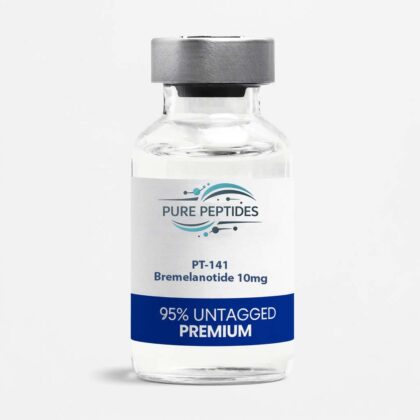
- PT-141 (Bremelanotide) — its own metabolite, the essential comparator for isolating MC1R from MC3R and MC4R activity.
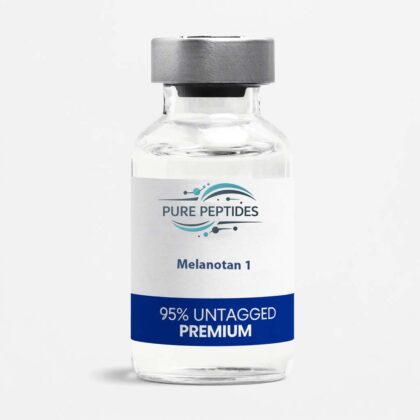
- Melanotan 1 — the MC1R-selective linear analogue, completing the selectivity series across the melanocortin family.
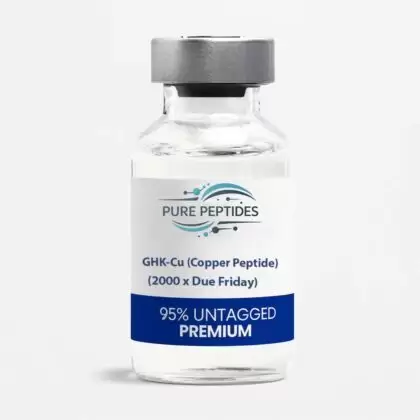
- GHK-Cu — a copper tripeptide studied in dermal research models, run in parallel where skin endpoints are assessed together.
Frequently Asked Questions
How does Melanotan 2 differ from Melanotan 1?
Melanotan 1 is a linear analogue selective for the MC1 receptor. Melanotan 2 is cyclic and engages MC1, MC3, MC4, and MC5 receptors broadly. That difference in selectivity is why the two are used for different research questions.
What is the relationship to PT-141?
PT-141, or bremelanotide, is a metabolite of this peptide, differing by the loss of a terminal amide group. That single change substantially reduces MC1 receptor affinity, shifting activity toward the MC3 and MC4 subtypes.
Why does the cyclic structure matter?
Native alpha-MSH is linear and degraded within minutes. Cyclization constrains the molecule into a stable conformation resistant to enzymatic cleavage, extending receptor engagement enough for the analogue to function as a practical laboratory tool.
How should this peptide be stored?
The sealed lyophilized vial should be stored desiccated below minus 18 degrees Celsius and protected from light. Once reconstituted, material should be held at 4 degrees Celsius for short-term use or below minus 18 degrees Celsius for longer-term storage.
Is this product approved for human use?
No. This material is a laboratory reference standard supplied strictly for in vitro and preclinical research. It has not been evaluated by the Food and Drug Administration and is not approved for therapeutic, diagnostic, or human application of any kind.
Regulatory Status
Melanotan 2 is supplied strictly for in vitro and preclinical research purposes. Its use is considered experimental; long-term safety and efficacy in humans have not been established. All referenced findings derive from published preclinical and clinical research, and results in one model may not translate to another.
Reviews
There are no reviews yet.